
Foil keyboards, customer-specific


About the product
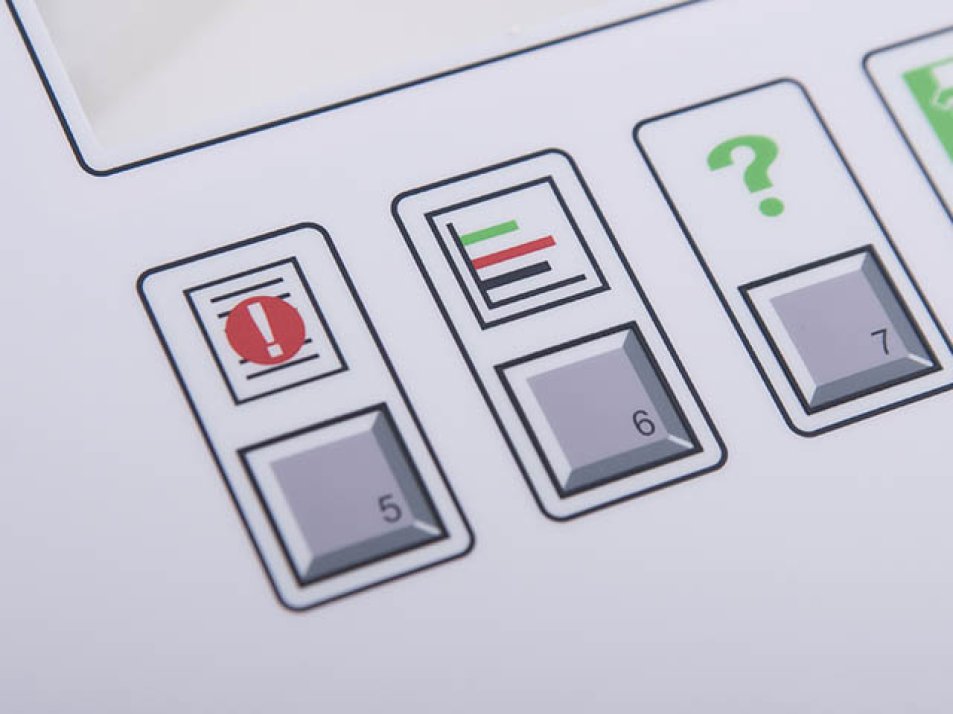
Membrane keyboards are the most widely used input devices in device construction. Whether they have a limited application area with two keys or are a complete user interface with a large number of functions. The robust design, flat installation depth and great degree of freedom in terms of their shape continue to make them the first choice for many.
The almost unlimited flexibility in design is one of the major advantages of foil-covered keyboards. As a result, the design engineer can freely set the number of keys, their position and their shape on the device. Then there is the equally wide selection of graphical designs for the user interface. Foil-covered keyboards as mechanical switching elements primarily offer thin metal dome switches. Secondly, the switching mechanism works when the foil surface contacts the switching film below. Foil-covered keyboards are normally glued into place without a great deal of effort to integrate them within systems.
The variety of additional functions and properties that can be combined with foil-covered keyboards are what make them an attractive proposition. Coatings that repel biocides or liquids, different lighting options, capacity sensor elements or a double contact function are all available.
Typical applications
-
 Winch
Winch
-
Crane & lifting
-
Heavy industry
-
Drilling & Rig
-
Ship's bridge & control room
-
Process
Manufacturer

About the product
Membrane keyboards are the most widely used input devices in device construction. Whether they have a limited application area with two keys or are a complete user interface with a large number of functions. The robust design, flat installation depth and great degree of freedom in terms of their shape continue to make them the first choice for many.
The almost unlimited flexibility in design is one of the major advantages of foil-covered keyboards. As a result, the design engineer can freely set the number of keys, their position and their shape on the device. Then there is the equally wide selection of graphical designs for the user interface. Foil-covered keyboards as mechanical switching elements primarily offer thin metal dome switches. Secondly, the switching mechanism works when the foil surface contacts the switching film below. Foil-covered keyboards are normally glued into place without a great deal of effort to integrate them within systems.
The variety of additional functions and properties that can be combined with foil-covered keyboards are what make them an attractive proposition. Coatings that repel biocides or liquids, different lighting options, capacity sensor elements or a double contact function are all available.
Contact
-
Jorn Jul-Larsen
Manager, Sales & Marketing, Agency
+47 95 87 00 22 -
Roy Dahl
Sales Engineer, Agency
+47 95900734